
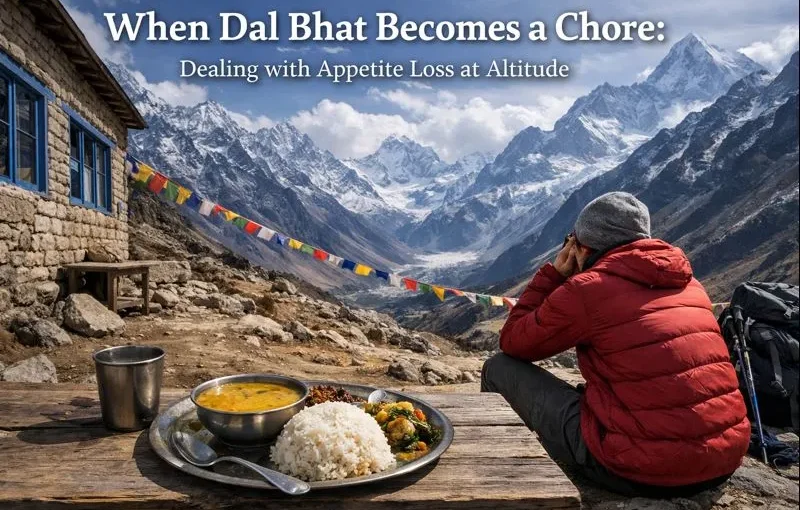
You’ve seen it on t-shirts and in guidebooks: “Dal Bhat Power 24 Hour.” For the first few days on a trek in Nepal, it holds true. The warm plate of lentil soup, rice, spinach, and maybe a potato curry feels hearty and reliable. Then, around day seven or eight, something shifts. You stare at the identical beige and green meal, and the thought of lifting the spoon feels like a task. This isn’t just boredom. It’s a quiet, persistent signal from your body that many choose to ignore until it’s a problem.
The Unspoken Trekking Wall: Food Aversion
For independent trekkers, especially those from Europe used to variety and personal control over their diet, this moment is a genuine wall. You plan your calories, you research nutrition, and you assume you’ll fuel your body as you would on a long hike back home. The reality is different. At altitude, your body’s priorities change. Digestion becomes harder work for a system focused on oxygen. Nausea, often subtle, creeps in. The sight and smell of the same spices, the same texture of lentils, can trigger a deep, visceral reluctance to eat.
Yet, you know you must. You have a six-hour walk to the next village over a high pass. The equation is brutally simple: no calories, no energy, no safe progress. This is where the romantic notion of trail food collides with the physical reality of high places.
Why No One Prepares You for This
Travel blogs and agency websites rarely dwell on this. It’s not good marketing. It’s easier to sell the colourful, exotic plate of Dal Bhat than to discuss the fatigue of eating it when you feel sick. There’s also a cultural buffer; it feels rude to criticise a staple food that families prepare for you with care. So, trekkers often suffer this loss of appetite in silent guilt, thinking it’s just them being picky or weak.
It’s also oversimplified. The common line is, “Loss of appetite is a sign of Acute Mountain Sickness (AMS).” This is true, but it frames it as a binary warning sign, not as a chronic, grinding experience that can happen even without severe AMS. The conversation stops at “descend if you have symptoms,” skipping the practical reality of the days before that decision, where you still need to eat.
The Kitchen Reality on the Trail
In the teahouse kitchen, the system is built for efficiency and fuel. Dal Bhat is affordable, scalable, and provides a balanced meal for trekkers. The menu might offer pizza or spring rolls, but at higher altitudes, these are often expensive and less reliably prepared. The Dal Bhat is the bedrock.
But it’s not uniform. In lower villages, you might get a fresh, varied plate with different seasonal vegetables. Higher up, above the tree line, it becomes more basic: lentils from a sack, rice, and perhaps dried or fermented greens. The consistency can be thicker, heavier. The cook, an Ama (mother, or lady of the house), is working with what the porters carried up. There is no weekly organic vegetable delivery.
Forcing the Fuel: Observations from the Trail
Watching seasoned trekkers, you see quiet strategies. The key is separating nutrition from appetite. Sweet, easily digestible calories often work when savoury food fails.
People carry electrolyte powder, like Gatorade or a local equivalent. Mixing a strong glass and sipping it can settle the stomach and provide simple sugars. Snickers bars, for all their processed nature, become prized not as treats but as medical supplies, easy to eat, high in calories and fat. You see people take tiny, deliberate bites between sips of ginger tea.
The most awkward moment is leaving food on the plate. In the Nepali hills, especially in family homes, this is seen as wasteful. The Ama will often watch, concerned. Her logic is direct and born of hard work: if you don’t eat, you won’t have strength. The social pressure to finish is real, even as your stomach turns.
A Short Conversation in a Dining Room
One evening, after pushing myself, I simply couldn’t finish. The Ama came over, pointing at my half-full plate.
“Khana na khaya kasari hidna saknu hunchha?” she said, not with anger, but with genuine, matronly concern. If you don’t eat, how will you be able to walk?
I gestured to my head and stomach, the universal trekker sign for altitude sickness. “Pet bhayo,” I said simply. The stomach.
She nodded, the concern not leaving her eyes. “Thorai thorai khaanu,” she said, making a small pinching motion with her fingers. Eat little by little. Then she brought over a small bowl of spicy pickled vegetables. “Yo mitho chha.” This is tasty. It was a pragmatic solution, not from a guidebook, but from a lifetime of seeing tired hikers.
The Picky Eater’s Dilemma at 4,000 Metres
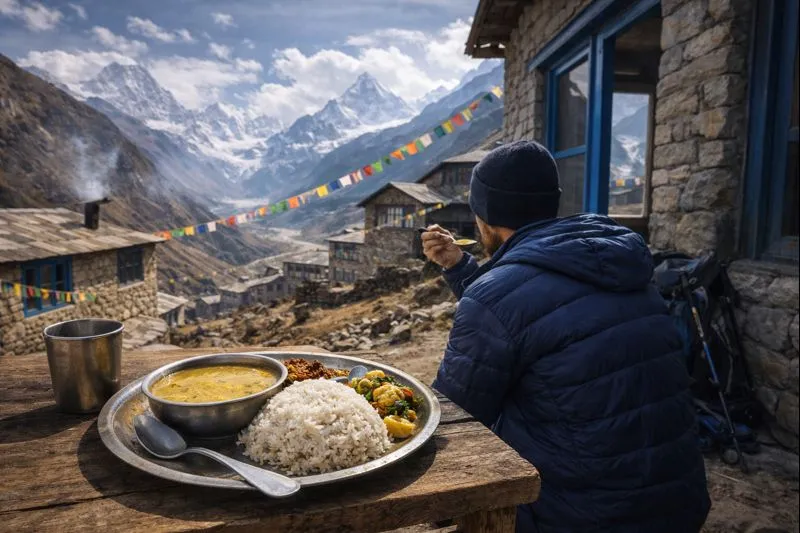
For those with dietary restrictions, gluten-free, vegan, or simply having strong preferences, this is where expectation meets a hard limit. You can communicate your needs, and most teahouses will try to accommodate. But “gluten-free” is an abstract concept in a village where flour is flour. Cross-contamination is certain. “Vegan” is easier, as Dal Bhat often is, but the understanding may not extend to the dollop of ghee (clarified butter) on top unless you explicitly and repeatedly refuse it.
The control you have at home vanishes. The choice becomes: stick rigidly to your principles and risk severe calorie deficit, or adapt within the possible. Most who succeed long-term on these trails learn a form of pragmatic flexibility, choosing their battles carefully.
Patterns That Work and Friction Points
What works is accepting the system and supplementing it. Trekkers who bring a selection of their own high-calorie snacks, nuts, chocolate, biscuits, fair better. Asking for “Gundruk” (fermented greens) is a good move; it’s a local staple, often tart and strong, and can shock a tired palate awake. It shows engagement with the real local diet, not just the tourist version.
What causes problems is frustration directed at the teahouse staff. They are not being monotonous to annoy you; they are providing the most reliable fuel they have. Insisting on complex off-menu items drains limited resources and patience. The other problem is ignoring the loss of appetite entirely, writing it off as simple fatigue. That’s how people become dangerously weak by day twelve.
Who Manages This Dal Bhat and Who Finds It Hard
This situation fits those who view the trek as a physical challenge that includes logistical and mental components. They pack strategically and mentally prepare for a degree of discomfort, including culinary monotony. They understand food primarily as fuel for the task.
People who struggle are often those for whom food is a major daily pleasure and comfort. There’s no shame in this; it’s a normal human trait. Younger backpackers sometimes underestimate the sheer caloric need and try to survive on snacks alone. Older trekkers with sensitive digestive systems can have a particularly tough time. The mental struggle is often harder than the physical one, the feeling of being trapped by a bowl of lentils.
A Quiet Realisation on the Descent
The strange thing is, after you descend below 3,000 metres, your appetite returns with a force. That same Dal Bhat, eaten in a warmer, thicker air, tastes different. The lentils are just lentils again, not a symbol of a struggle. You remember the Ama’s concern not as pressure, but as a kind of rough care, a recognition that in these mountains, food is not just culture, it is literal momentum. The “power” isn’t in the dish itself, but in the act of eating it when every signal tells you not to. That’s the part they don’t put on the t-shirt.


 English
 Deutsch
 Svenska
 Dansk
Dansk Русский
 Français
 Português
 Español
 Polski
 简体中文
简体中文 日本語
日本語 ไทย
ไทย العربية
 한국어
한국어