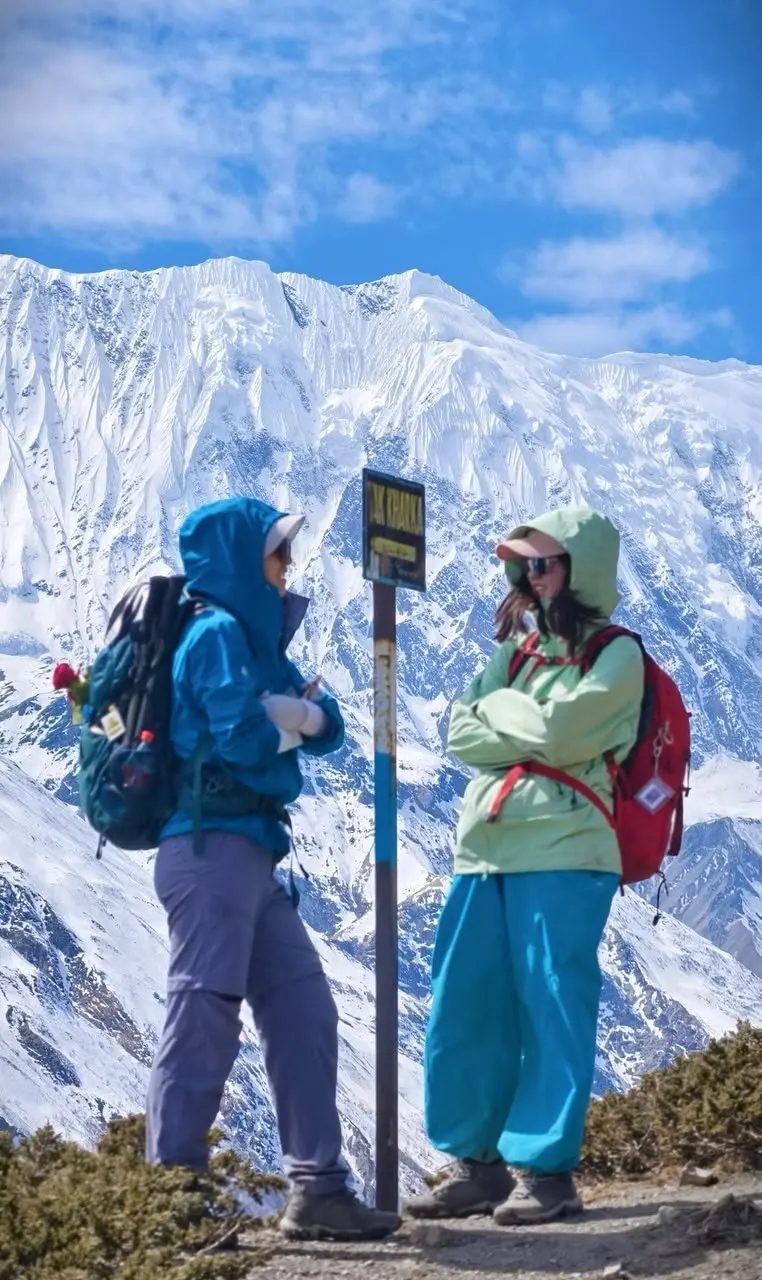
- Duration
- 11 days
- Max altitude
- 4,850 m
- Difficulty
- Challenging
- Group size
- Max 10
- Daily walking
- 5–7 h / day
- Trekking distance
- About 64 km
- From
- US$699
Region: Annapurna Region
Overview
The Annapurna Circuit Trek is the classic Himalayan circuit, and the first thing guests ask us is whether they're fit enough for the Thorong La. Our honest answer: this 11-day version suits hill walkers who can handle 5–6 hours of walking a day and who want a shorter, sharper taste of the circuit. It's challenging because of the altitude, not the technical ground. We start in Kathmandu, drive to Chame, walk up the Marsyangdi valley to Manang, cross the Thorong La at 5,416 m, then drop to Muktinath and Jomsom. The highest point is the pass; the highest sleeping altitude is High Camp at 4,850 m. The trip ends with a drive back to Kathmandu.
The route unfolds in a clear rhythm. From Chame (2,710 m) we follow the river through pine forest to Lower Pisang (3,200 m), where the valley opens and the first big peaks appear. Then to Manang (3,540 m), a busy village of flat-roofed houses and bakeries. We take a rest day there to acclimatise, with a short climb to a viewpoint above the village. From Manang we walk to Yak Kharka (4,050 m), then up to High Camp (4,850 m). The next day is the long one: we leave before dawn for the Thorong La (5,416 m) and descend to Muktinath (3,800 m). A short walk and a drive take us to Jomsom, then a flight or drive to Pokhara and back to Kathmandu.
The people we meet are part of the route. In the upper villages we pass mani walls and prayer wheels, and in Manang there's a small monastery and a cultural centre that explains the local way of life. The trail is also a working road in places, with jeeps and motorbikes, so we walk the quieter paths where we can. We often stop at Besisahar on the way in, and the change from green hills to dry, windy plateau is something guests notice. If you're wondering how the road affects the walking, we've written about the Annapurna Circuit road reality.
We pace the trip for altitude carefully. Above 3,000 m we keep sleeping gains to about 500 m a day, and the rest day in Manang is there for a reason. Each morning we check how everyone slept, whether they have a headache, and how they feel on the first climb. If someone is struggling, we adjust the day. We carry a pulse oximeter and a first-aid kit, and our guides are trained to spot the early signs of altitude sickness. We also build in a weather buffer around the pass day. For more on this, see our article on altitude sickness on the Annapurna Circuit.
Accommodation is in teahouses and lodges, simple but comfortable, with twin rooms and shared bathrooms. Higher up the rooms are basic and the dining hall is where everyone gathers around the stove. Food is what you'd expect on a trek: dal bhat, noodles, soups, eggs, potatoes, and sometimes pizza or apple pie in Manang. We eat early and drink plenty of water. In Pokhara we stay in a hotel, and in Kathmandu too. The trip cost covers permits, guides, porters, accommodation and most meals; we don't publish prices online because they change with group size and season, so ask us for a current quote.
The best time for the Annapurna Circuit Trek is spring (March to May) and autumn (late September to November). In spring the rhododendrons are out lower down and the days are warmer, though there can be haze. In autumn the skies are usually clear and the views sharp, but it's colder at night. Winter can be done but the pass may be closed by snow, and the monsoon (June to August) brings rain, leeches and cloudy views. Whatever the season, the trail is busy in October and April, so we book teahouses ahead.
What guests carry home from this trip is usually a mix of tired legs and a quiet sense of having crossed something big. The Thorong La is a serious pass, and standing there at 5,416 m with the wind and the prayer flags is a moment many remember. If you're thinking about dates, have a look at our fixed departures or send us a message. We're happy to talk through fitness, training and what to pack. And if you're comparing routes, our guide to how many days you need for a safe Annapurna Circuit might help.
Highlights
- Cross Thorong La (5,416 m), one of the highest trekking passes in the world
- Walk through the diverse landscapes of the Annapurna Conservation Area
- Explore the ancient village of Manang and its monasteries
- Visit Muktinath Temple, a sacred pilgrimage site
- Experience teahouse life and local culture along the trail
- Experiences the little Tibet in Nepal
Day-by-day itinerary
Day 1: Arrival in Kathmandu
1,400 m
We meet you at Tribhuvan International Airport and drive to your hotel in Kathmandu. The rest of the day is free to rest and prepare for the trek. In the evening we have a briefing about the days ahead, and you can ask any questions.Day 2: Kathmandu to Besisahar by bus, then jeep to Chame
2,710 m · Breakfast, Lunch, Dinner
We leave Kathmandu early and take a bus to Besisahar, the gateway to the Annapurna Circuit. From there we switch to a jeep for the rough road to Chame, passing through rice fields and villages. The drive takes most of the day, and we arrive in Chame in the afternoon.Day 3: Chame to Lower Pisang
3,200 m · 5–6 h · Breakfast, Lunch, Dinner
We start walking from Chame, following the Marsyangdi River through pine forests. The trail is relatively easy, with some ups and downs, and we pass through the village of Telekhu and Bratang. We stop for lunch at Dhikur Pokhari and continue to Lower Pisang, where we spend the night.Day 4: Lower Pisang to Manang
3,540 m · 5–6 h · Breakfast, Lunch, Dinner
We climb to Upper Pisang for views of Annapurna II and IV, then follow the trail through the village of Ghyaru and Ngawal. The landscape becomes drier and more open as we approach Manang. We descend to the wide valley floor and reach Manang, a large village with monasteries and shops.Day 5: Rest and sightseeing in Manang
3,540 m · Rest day · Breakfast, Lunch, Dinner
We spend the day in Manang to acclimatise. In the morning we can hike to the Gangapurna Lake or visit the monastery. The afternoon is free to rest and explore the village. Our guide will check your health and give advice for the coming days.Day 6: Manang to Yak Kharka
4,050 m · 4–5 h · Breakfast, Lunch, Dinner
We leave Manang and climb gradually through juniper and scrub. The trail offers views of the Annapurna range and the valley below. We pass through the small settlement of Gunsang and reach Yak Kharka, a grazing area with a few teahouses.Day 7: Yak Kharka to High Camp
4,850 m · 4–5 h · Breakfast, Lunch, Dinner
We continue climbing towards Thorong La, passing through Thorong Phedi and then up to High Camp. The trail is steep in places, and the altitude makes it slow going. We stop for lunch at Thorong Phedi and then walk another hour to High Camp, where we sleep at 4,850 m.Day 8: High Camp to Muktinath via Thorong La
3,800 m · 7–9 h · Breakfast, Lunch, Dinner
We start early in the dark to cross Thorong La (5,416 m) before the wind picks up. The climb is steady but slow, and we reach the pass after 3–4 hours. From there we descend for several hours to Muktinath, a sacred site with a temple and monastery. We sleep in a teahouse in Muktinath.Day 9: Muktinath to Jomsom, drive to Pokhara
820 m · 3–4 h · Breakfast, Lunch
We walk down from Muktinath to Jomsom, a windy town in the Kali Gandaki valley. The trail passes through Kagbeni, a medieval village, and follows the riverbed. From Jomsom we take a jeep to Pokhara, a long drive that takes most of the afternoon.Day 10: Pokhara to Kathmandu
1,400 m · Breakfast
We take a tourist bus back to Kathmandu, a journey of about 7–8 hours. The road follows the Trishuli River and passes through terraced fields and villages. We arrive in Kathmandu in the late afternoon and transfer to your hotel.Day 11: Departure
Breakfast
We transfer you to Tribhuvan International Airport for your flight home. If you have time, you can explore Kathmandu's markets or visit a temple before your flight.
What's included
- Licensed English-speaking trekking guide
- All permits (ACAP and TIMS)
- Teahouse accommodation on the trek
- Meals as specified in the itinerary
- Transportation as per itinerary
Not included
- International flights and Nepal visa
- Travel and rescue insurance
- Personal expenses (drinks, snacks, hot showers, charging)
- Tips for guide and porters
- Porter services add on available(100 USD)
Permits
- Annapurna Conservation Area Permit (ACAP)
- Trekkers' Information Management System (TIMS) card
Fitness & eligibility: Annapurna Circuit Trek
Who can join
- This trek suits healthy walkers who have done at least one multi-day trek before.
- You should be comfortable walking 5 to 7 hours a day for several days in a row.
- You need travel insurance that covers trekking to 5,000 m and helicopter evacuation.
- You should be able to cross Thorong La (5,416 m) on foot in cold, windy weather.
Fitness required
- Able to walk 5 to 7 hours a day for several days, with a long climb to High Camp (4,850 m).
- Able to carry a day pack up steep, rocky trails for 6 to 8 hours on the longest days.
- Train in the weeks before with hill walks, stairs and long weekend hikes in your boots.
- Build leg and core strength, and practise walking slowly on climbs so your breathing stays steady.
Health and awareness
- Tell us before booking about heart, lung or blood pressure conditions, diabetes or recent surgery.
- Ask your doctor about the trip if you are pregnant or unsure how your body handles altitude.
- Watch for headache, nausea, dizziness or breathlessness that does not settle, and tell your guide at once.
- Drink enough water each day and keep to the rest day in Manang (3,540 m) and the slow ascent.
- Do not go higher with symptoms of altitude sickness, and let your guide decide on any descent.
Things to Carry / Packing
- Waterproof hiking boots
- Down jacket and fleece mid-layer
- Thermal base layers and warm hat and gloves
- Sleeping bag (rated to -10°C)
- Headlamp and extra batteries
- Water purification tablets or filter
- First aid kit with personal medications