
-
Flight + Private Vehicle
-
Max 6
-
7161
-
Star Hotel, Tea House, Base Camp Camping
-
Very High
-
Kathmandu
-
Kathmandu
-
Spring (March to May) brings warming weather, rhododendron blooms, and reliable mountain visibility. Autumn (September to November) offers the clearest skies, crisp air, and stable trekking conditions. Winter (December to February) is cold but possible on lower routes. Summer monsoon (June to August) brings rain and obscured views.
-
Live Personal Climbing Guide (Sherpa)
-
Expedition
-
English
-
Includes (BLD) + Expedition Camp Meals
-
Climbing Permit (Ministry of Tourism), Sagarmatha National Park Entry Permit, Khumbu Pasang Lhamu Rural Municipality Entry Permit, TIMS Card, Garbage Deposit.
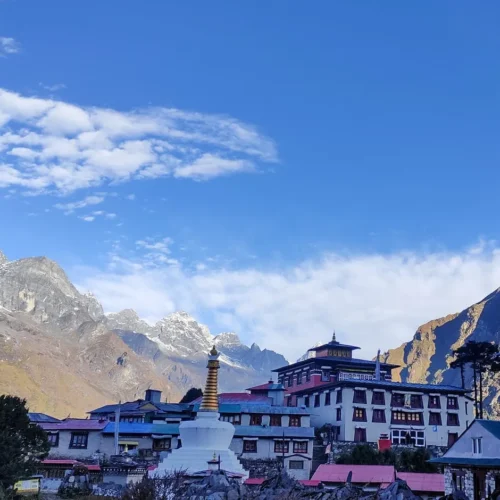
Pumori (7,161m / 23,494 ft) is an expedition peak in the Khumbu region of north-east Nepal, located on the Nepal-Tibet border immediately west of Everest Base Camp and Kala Patthar. The peak lies at approximately 27 degrees 58 minutes north latitude and 86 degrees 49 minutes east longitude, in the Sagarmatha National Park. The name Pumori means Unmarried Daughter in Sherpa, and the mountain is often called Everest Daughter due to its proximity to Everest and its similar pyramid shape. Pumori was first climbed on 17 May 1962 by a German-Swiss expedition led by Ernst Forrer, via the southeast face. The mountain is classified as an expedition peak requiring a climbing permit from the Ministry of Tourism.The standard route climbs the southeast face, with Base Camp at approximately 5,300m near Everest Base Camp. The route establishes three high camps: Camp 1 at 5,700m on a broad snow shoulder, Camp 2 at 6,100m at the base of the southeast ridge, and Camp 3 at 6,500m on the ridge itself. The summit push from Camp 3 involves climbing 40-50 degree snow slopes with some short ice pitches on the upper mountain, with the final section traversing an exposed summit ridge to the top. The technical difficulty is rated AD+ on the Alpine grading system.Pumori is one of the most popular 7,000m expedition peaks in Nepal due to its proximity to Everest Base Camp and the famous viewpoint of Kala Patthar (5,545m) at its base. The mountain is significantly more technical than Himlung Himal but is accessible to climbers with previous 6,000m peak experience and solid snow and ice climbing skills. The summit rewards climbers with one of the best views of Everest (8,849m) in the entire region – the summit looks directly across the Western Cwm at the South Col and the Southeast Ridge climbing route of Everest. The summit also offers views of Lhotse (8,516m), Nuptse (7,861m), Changtse (7,543m), and the Khumbu Glacier below.The approach follows the classic Everest Base Camp trekking route from Lukla through Namche Bazaar, Tengboche, Dingboche, Lobuche, Gorak Shep, and Kala Patthar to Pumori Base Camp at 5,300m. The region is culturally Tibetan Buddhist Sherpa homeland, with traditional villages, ancient monasteries at Tengboche and Pangboche, and prayer walls along the trail. The best climbing seasons are spring (April-May) and autumn (October-November), with spring being more popular for Pumori due to more stable snow conditions.
Highlights
- Climb a 7,161m expedition peak first summited in 1962 by a German-Swiss expedition led by Ernst Forrer.
- Known as Everest Daughter due to its proximity to Everest and similar pyramid shape.
- Three high camps at 5,700m, 6,100m, and 6,500m on the southeast face route.
- Summit offers one of the best views of Everest in the entire region.
- Approach via the classic Everest Base Camp trek through Namche and Tengboche.












 English
 Deutsch
 Svenska
 Dansk
Dansk Русский
 Français
 Português
 Español
 Polski
 简体中文
简体中文 日本語
日本語 ไทย
ไทย العربية
 한국어
한국어