- Tempoh
- 18 hari
- Altitud maksimum
- 4,100 m
- Tahap kesukaran
- Meletihkan
- Saiz kumpulan
- Max 10
- Berjalan harian
- 5–7 h / day
- Jarak trekking
- About 119 km
- Dari
- US$1,990
Wilayah: Wilayah Nepal Barat
Gambaran Keseluruhan
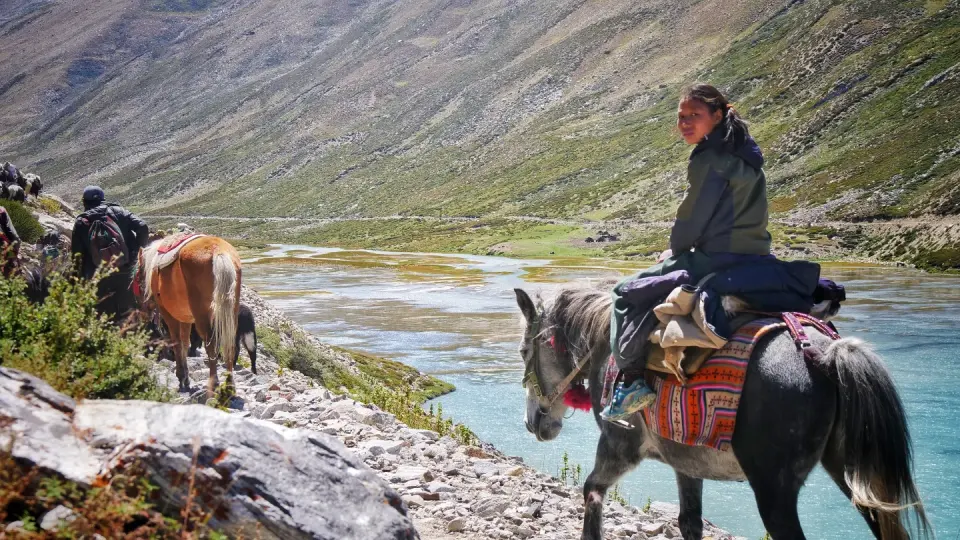
People write to us about the Humla Limi Valley trek because they want the far west of Nepal, not another busy trail in the Khumbu. The honest answer is that this is a strenuous 18-day trip, and the walking days are long and often above 3,000 m. It starts with flights from Kathmandu to Nepalgunj and on to Simikot, ends the same way, and the highest point is the Nyalu La pass at about 4,900 m, with our highest overnight at Til at 4,100 m. It suits fit walkers who have trekked before, who don't mind basic lodges and camp some nights, and who want a quiet, culturally Tibetan corner of Nepal.
The route unfolds in a clear order. From Simikot we drop to Dharapuri at 2,300 m, then climb through Kermi at 2,670 m and its old gompa, Yalbang at 3,020 m with its monastery above the Karnali, and Muchu at 3,120 m. We follow the Salli Khola up to 3,700 m, cross the Nyalu La to Halji at 3,650 m, take a rest day there, then walk to Til at 4,100 m, Manepeme at 3,990 m and Talung at 3,700 m. From Talung we turn back through Kermi and up to Simikot, then fly out. If you want the day-by-day detail, our guide to a realistic Limi Valley itinerary from Simikot sets it out plainly.
The people are the reason many guests remember this trek. Limi is one of the last places in Nepal where the villages are still largely Tibetan-speaking, and Halji, Til and Jang hold old monasteries with painted walls and a rhythm of daily practice. We walk past mani walls, chortens and fields of barley and buckwheat, and in the villages we stay in family lodges where the kitchen is the warmest room. Our guides speak Nepali and enough local language to introduce you properly, and we ask guests to keep cameras respectful during prayers.
Altitude is the part we take most seriously. Above 3,000 m we keep sleeping gains to about 500 m a day where the route allows, and the rest day at Halji is there for a reason, not as padding. Each morning we check how everyone slept, whether there is a headache, and how the appetite is, and we adjust the day if needed. The Nyalu La day is the big one: we start early, walk steadily, and turn back without argument if the weather or a person's condition says so.
Where we sleep depends on the section. In Kathmandu and Nepalgunj we use hotels, and in Simikot a simple guesthouse. On the trail we stay in village lodges where they exist, and on the higher stretches between Salli Khola and Talung we camp, with our crew carrying tents, food and cooking gear. Meals are plain and filling: dal bhat, noodles, potatoes, local buckwheat bread, and hot drinks. Our Limi Valley trek package guide explains what we bring and what you carry.
The best time to walk this route is the usual two windows: late March to May, when the valleys green up and the high pass is usually open, and September to early November, when the air is clearer and the post-monsoon colours are strong. In spring there can be snow left on the Nyalu La, and in autumn the nights above 3,500 m are cold. We build a weather buffer into the flights because Simikot is famously unreliable, and we tell guests at the briefing that a delayed flight is normal, not a crisis.
What guests carry home is usually quieter than they expect. It is the walk over the Nyalu La, the sound of the monastery at Halji in the morning, and the feeling of being somewhere that tourism has not reshaped. This is a trek for people who want that, and who are ready for the effort it asks. If you are thinking about it, look at our dates or send us a question, and we will tell you honestly whether the Humla Limi Valley trek fits your experience and your fitness.
Sorotan
- Cross the Nyalu La at 5,001 m on the way into the Limi Valley
- Two nights at Halji at 3,650 m to acclimatise before going higher
- Walk through the old monastery village of Til at 4,100 m
- Follow the Karnali gorge from Simikot through Kermi and Yalbang
- See the Tibetan-style villages of the Limi Valley close to the border
- Small guided group with porters and all permits arranged
Jadual perjalanan hari demi hari
Hari 1: Arrival in Kathmandu
1,400 m
We meet you at Tribhuvan International Airport and drive to your hotel in the city. The afternoon is free to rest and buy anything missing from your kit. In the evening we brief you on the flights to Humla, the days on the trail and how we manage altitude.Hari 2: Fly to Nepalgunj
150 m · Sarapan
We take the short flight west to Nepalgunj in the Terai, which takes about an hour and a half. The town is hot and flat after Kathmandu, and we use the afternoon to check the onward flight and rest. We sleep low on purpose, which helps before Simikot.Hari 3: Fly to Simikot
2,960 m · Sarapan
We fly north to Simikot on a small aircraft, weather permitting, with views of the Karnali valley and the first high ridges. Simikot is a compact hill town at 2,960 m, and the jump in altitude is real, so the rest of the day is slow. We check permits and walk a little in the afternoon.Hari 4: Trek to Dharapuri
2,300 m · 5–6 h · Sarapan, Makan tengah hari, Makan malam
We leave Simikot on a trail that drops through terraced fields and pine woods towards the Karnali. The path loses height for most of the morning, which helps us adjust, and we cross a few small streams on wooden bridges. We sleep at Dharapuri, a cluster of houses with a basic teahouse.Hari 5: Trek to Kermi
2,670 m · 6–7 h · Sarapan, Makan tengah hari, Makan malam
We follow the Karnali river upstream, crossing a long suspension bridge and passing a hot spring near the trail. The valley narrows and the path climbs and falls along the bank before we reach Kermi. There is a small monastery above the village, and we usually have time to visit it in the afternoon.Hari 6: Trek to Yalbang
3,020 m · 6–7 h · Sarapan, Makan tengah hari, Makan malam
The trail climbs above the river through pine forest and past mani walls, with the Karnali roaring below. We cross a high suspension bridge and walk on to Yalbang, where there is a well-known monastery and a small school. The village sits at 3,020 m, so we are back above 3,000 m and walk slowly.Hari 7: Trek to Muchu
3,120 m · 4–5 h · Sarapan, Makan tengah hari, Makan malam
We walk a shorter day along the river to Muchu, passing a small hydro station and a suspension bridge. The valley opens a little and the slopes become drier and more eroded. We sleep at 3,120 m, which keeps the gain modest before the climb to Salli Khola.Hari 8: Trek to Salli Khola
3,700 m · 5–6 h · Sarapan, Makan tengah hari, Makan malam
We leave the Karnali and climb into a side valley, with juniper and grass giving way to bare rock. The path is rough in places and the air thins as we go, so we take it slowly with plenty of short stops. We camp or stay in a basic lodge at Salli Khola at 3,700 m, close to the foot of the pass.Hari 9: Cross Nyalu La to Halji
3,650 m · 7–8 h · Sarapan, Makan tengah hari, Makan malam
This is the longest and highest day of the trek. We start before dawn and climb steadily to the Nyalu La at 5,001 m, where the wind is usually strong and the view opens across the Limi basin. We descend carefully on the far side to Halji at 3,650 m, a Tibetan-style village with barley fields and a famous old monastery.Hari 10: Rest day in Halji
3,650 m · Rest day · Sarapan, Makan tengah hari, Makan malam
We stay put in Halji to let the body adjust after the pass. The day is free to walk around the village, visit the monastery and watch the barley fields being worked. Our guide checks how everyone feels and we decide together how the next days will run.Hari 11: Trek to Til
4,100 m · 5–6 h · Sarapan, Makan tengah hari, Makan malam
We walk north through the Limi Valley past Jang and on to Til, with wide views of the Tibetan plateau to the east. The trail is open and exposed, with little shade, and the villages are small and quiet. We sleep at Til at 4,100 m, the highest night of the trek.Hari 12: Trek to Manepeme
3,990 m · 5–6 h · Sarapan, Makan tengah hari, Makan malam
We leave Til and follow the valley south, with the border ridges on our left and open grazing land around us. The path is rough and stony in places, and we cross a few small streams. We sleep at Manepeme at 3,990 m, a small settlement with basic rooms.Hari 13: Trek to Talung
3,700 m · 5–6 h · Sarapan, Makan tengah hari, Makan malam
We continue south through open country, with the Nyalu La behind us and the Karnali valley ahead. The trail drops gradually and the air feels easier as we lose height. We sleep at Talung at 3,700 m, a small village with a few teahouses.Hari 14: Trek to Kermi
2,670 m · 6–7 h · Sarapan, Makan tengah hari, Makan malam
We walk down towards the Karnali, rejoining the main Humla trail near Kermi. The descent is long and steady, with forest returning as we lose height. We sleep again at Kermi at 2,670 m, where the air is noticeably warmer.Hari 15: Trek to Simikot
2,960 m · 6–7 h · Sarapan, Makan tengah hari, Makan malam
We follow the river and then climb back up to Simikot through terraced fields and pine woods. The last hour is a steady uphill to the town, and it feels longer than it looks. We sleep in Simikot at 2,960 m and check the flight for the next day.Hari 16: Fly to Nepalgunj
150 m · Sarapan
We take the small aircraft back to Nepalgunj, again weather permitting. The flight is short and the change in heat and air is sudden after two weeks in Humla. The rest of the day is free to rest and eat well.Hari 17: Fly to Kathmandu
1,400 m · Sarapan, Makan malam
We fly back to Kathmandu and drive to the hotel. The afternoon is free for a hot shower, a proper meal and a little shopping in Thamel. In the evening we meet for a farewell dinner together.Hari 18: Final departure
Sarapan
We drive you to the airport in time for your international flight. If your flight leaves late, the morning is free for last-minute shopping. We say goodbye at the terminal and hope to walk with you again.
Apa yang disertakan
- Licensed English-speaking trekking guide
- Porters, one for two trekkers, to carry the main duffel
- Kathmandu to Nepalgunj and Nepalgunj to Simikot flights, and the return legs
- Teahouse accommodation on the trail
- Three meals a day on trekking days
- Humla and Limi Valley permits and TIMS card
- Airport transfers in Kathmandu
- Duffel bag and route map
Tidak termasuk
- International flights and Nepal visa
- Hotels and meals in Kathmandu outside the listed days
- Travel and rescue insurance
- Personal expenses, hot showers, charging and Wi-Fi on the trail
- Tips for guide and porters
- Extra nights caused by flight delays
Permit
- Humla district entry permit
- Limi Valley restricted-area permit
- Trekkers' Information Management System card
- Simikot checkpost registration
Kecergasan & kelayakan: Humla Limi Valley Trek
Siapa boleh sertai
- You are in general good health and can commit to 18 days on a remote route with basic lodges.
- You have done at least one multi-day trek before, ideally with a pass above 3,500 m.
- Your travel insurance covers trekking to 4,100 m and helicopter evacuation.
- You accept that mountain flights to and from Simikot can be delayed by weather.
Kecergasan diperlukan
- Able to walk 5 to 7 hours a day for more than a week in a row on rough, rocky ground.
- Able to climb steadily for several hours on the Nyalu La crossing day, with steep sections.
- Build your hill walking in the weeks before, working up to long days with a loaded pack.
- Train on stairs or slopes so your legs and lungs are ready for the long descent to Kermi.
Kesihatan dan kesedaran
- Tell us before booking about heart, lung or blood pressure conditions, diabetes, recent surgery or pregnancy.
- Ask your doctor about altitude and any medication you take before you commit to this trek.
- Watch for headache, nausea, dizziness or poor sleep and tell your guide at once.
- Drink enough water each day and follow the acclimatisation days, including the rest day in Halji.
- Above 3,000 m, go slowly, eat well and speak up early if you feel unwell.
Kelengkapan & Barang Dibawa
- Broken-in waterproof hiking boots
- Down jacket and fleece mid-layer
- Thermal base layers, warm hat and gloves
- Four-season sleeping bag rated to about −15 °C
- Waterproof shell jacket and trousers
- Sun hat, sunglasses and high-factor sunscreen
- Head torch, water bottles and purification tablets
- Small first-aid kit and personal medicines