
소개
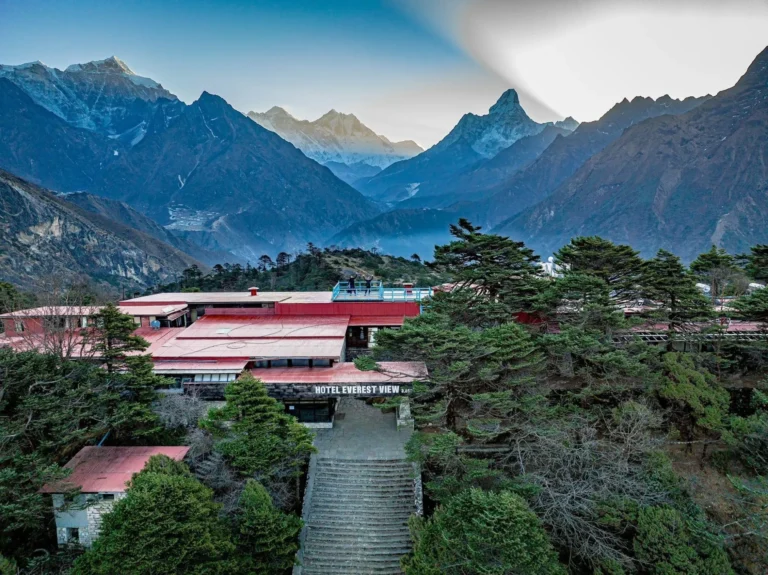
Dingboche is the main acclimatization village above 4,000m on the Everest trail — a broad farming settlement in a sheltered valley with spectacular peaks on all sides.
위치 Solukhumbu 고도의 지구 4,410 m (14,469 ft), Dingboche is a key stop on the EBC Trek within the Everest Region. The nearest settlement is Duglha. Trekkers reach Dingboche as part of the standard trekking route.
역사
Dingboche developed as a year-round settlement because its valley is sheltered and receives enough sun for barley and potato farming at high altitude.
The everest region has been a corridor for trade, pilgrimage, and mountaineering for centuries. Dingboche has witnessed the evolution of Nepal’s trekking industry, from the early expeditions of the 1950s to the modern tea-house network that today supports thousands of trekkers each year.
Local traditions reflect the deep cultural heritage of the Himalayan peoples, including the Sherpa. Oral histories, monastery records, and oral traditions document centuries of settlement, religious practice, and adaptation to high-altitude life.
지리 및 풍경
Dingboche lies in the Everest Region of Nepal at 4410 metres above sea level. The landscape is characteristic of the Nepal Himalaya — dramatic valleys, glacial moraines, alpine meadows, and forested ridgelines shaped by tectonic uplift and glacial retreat over millions of years.
The surrounding topography includes peaks, ridges, and river systems that define the trekking approach. The altitude places Dingboche in the alpine zone, with corresponding vegetation and wildlife.
고도 및 위치
- 높이: 4,410 m / 14,469 ft
- 좌표: 27.8667° N, 86.8333° E
- 지구: Solukhumbu
- 지역: 에베레스트 지역
- 경로: EBC 트렉
도달 방법
Dingboche is reached on foot as part of the standard EBC Trek itinerary.
이전 정류장에서 도보 시간: 4 hours from Pangboche (7 km).
트레킹 경로 정보
- 난이도: Challenging
- 도보 시간: 4 hours from Pangboche
- 이전과의 거리: 7 km
- 최고의 시즌: 봄(3~5월), 가을(9월~11월)
기대하는 것
A typical day at Dingboche begins with the morning Himalayan light filtering through the peaks, followed by breakfast at a teahouse, a steady walk along the trail, and an evening in a warm lodge sharing dal bhat with fellow trekkers and local hosts. The altitude (above 3,500m) requires careful acclimatization and the weather can change rapidly — pack layers and stay hydrated.
할 일
- Acclimatization hike to Nangkartshang Peak (5,083m)
- View Island Peak (Imja Tse)
- Rest day for altitude adaptation
- Sunset over Lhotse and Nuptse
숙박 및 찻집
Dingboche has approximately 18 teahouses and lodges, with lodges, electricity, Wi-Fi, hot showers, mobile network. Rooms are typically basic — twin beds, blankets, and shared bathrooms. Meals include dal bhat, momos, and Tibetan-style dishes.
음식 및 다이닝
Dal bhat, momos, pasta, garlic soup (popular for altitude) Teahouse menus typically feature dal bhat (rice and lentils), momos (dumplings), Tibetan bread, tsampa (roasted barley flour), butter tea, and seasonal vegetables. At higher altitudes, menus are more limited and prices rise due to the cost of transporting supplies.
문화와 커뮤니티
- 민족 그룹: Sherpa
- 언어: Sherpa, Nepali, English
The communities of the Everest Region have preserved their distinctive traditions through centuries of relative isolation. Daily life blends religious practice, agriculture, herding, and — increasingly — trekking tourism.
종교와 전통
- 수도원: Small village gompa
- 전통: Nyingma Buddhism; heavy acclimatization culture
종교적 풍경은 티베트 불교, 힌두교, 그리고 일부 지역에서는 불교 이전의 뵐과 샤머니즘 전통을 혼합합니다. 기도 깃발, 마니 벽, 초르텐, 곰파는 일상 생활의 일부입니다.
야생 동물과 자연
The ecosystems around Dingboche may include Himalayan tahr, blue sheep, musk deer, snow leopard (rare), Himalayan marmot, pika, lammergeier, Himalayan griffon, and Himalayan monal and blood pheasant. Flora ranges from alpine meadow and juniper scrub to alpine meadow.
방문하기 가장 좋은 시간
Spring (Mar–May), Autumn (Sep–Nov). Spring (March–May) brings rhododendron blooms and warming temperatures, while Autumn (September–November) offers the clearest skies and most stable weather. Winter (December–February) brings deep snow and cold that can close high passes. Summer (June–August) is the monsoon season with rain, leeches, and reduced visibility, though the rain-shadow regions of Mustang, Dolpo, and upper Manang remain accessible.
사진
- 포토 스팟: Nangkartshang summit with Makalu views
- Sunrise viewpoints: Nangkartshang
최고의 빛은 일출 후와 일몰 전의 골든 아워입니다. 눈을 위한 편광판, 풍경을 위한 광각, 먼 봉우리와 야생 동물을 위한 망원을 휴대하세요. 사람을 촬영하기 전에 항상 물어보십시오.
여행 팁
- 점차적으로 적응하십시오 — 하루에 3,000m 이상에서 수면 고도가 400-500m 이상 증가하지 마십시오.
- 현금(네팔 루피) — ATM은 지역 본부보다 드물다.
- 팩 레이어 — 고도와 시간에 따라 온도가 급격히 흔들립니다.
- 리필 가능한 물병과 정수 정제 또는 필터를 가져오십시오.
- 지역 문화 존중 — 사리탑과 마니 벽을 시계 방향으로 둘러싸고 사람들을 촬영하기 전에 물어보고 겸손하게 옷을 입습니다.
- 5,000m 이상의 헬리콥터 대피를 보장하는 여행 보험에 가입하십시오.
인근 명소
Chhukung, Island Peak, Imja Tse
Side trips: Chhukung, Island Peak Base Camp
자주 묻는 질문
What is the elevation of Dingboche?
Dingboche is at an elevation of 4,410 m (14,469 ft).
Is there Wi-Fi at Dingboche?
예, 대부분의 찻집에서 Wi-Fi를 사용할 수 있습니다(때로는 유료).
When is the best time to visit Dingboche?
봄(3~5월), 가을(9월~11월).
How do I reach Dingboche?
Dingboche is reached on foot as part of the EBC Trek.
결론
Dingboche is a memorable stop on any Everest Region trek — combining rich cultural heritage, dramatic Himalayan landscapes, and the warm hospitality of Nepal’s mountain communities. Combine careful planning with an open mindset to make the most of the journey to this remarkable corner of the Nepal Himalaya.


 English
 Deutsch
 Svenska
 Dansk
Dansk Русский
 Français
 Português
 Español
 Polski
 简体中文
简体中文 日本語
日本語 ไทย
ไทย العربية
 한국어
한국어