
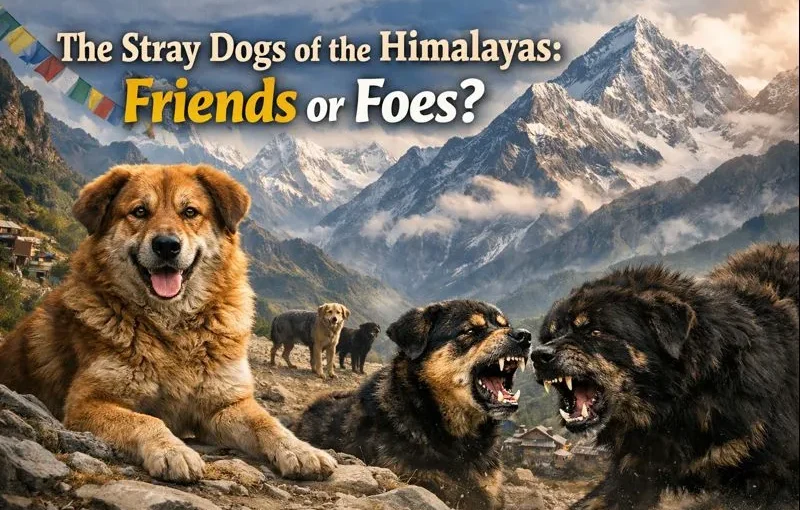
You’re a day or two from the nearest road. The air is thin, your legs are tired, and the silence is deep. Then you hear the barking of stray dogs. It’s not the friendly bark from a backyard. It’s an echo that bounces off the valley walls. You round a corner, and there he is, a large, rangy dog, standing in the middle of the trail, looking straight at you. Your heart does a small, quick jump. Do you smile? Do you reach for a snack? Do you prepare for a bite?
Why No One Gives You a Straight Answer
Tour operators and polished blogs often avoid this topic. It’s uncomfortable. It shatters the pristine image of the mountains. Talking about rabies, aggression, or the moral quandary of ignoring a hungry animal isn’t good for marketing. It’s easier to post a cute picture of a dog with a Himalayan backdrop and move on. The reality is messy, inconsistent, and requires a shift in thinking that no one wants to explain to a client before they’ve paid.
How Dogs Live on the Trails
The system is informal and local. In villages, dogs are loosely associated with a cluster of houses or a lodge. They are semi-owned, fed scraps, and tolerated. Between settlements, dogs are more autonomous. They patrol territories that can span several valleys. Their behavior isn’t random; it’s dictated by location, time of day, and their own survival logic.
Day vs. Night Behavior of Stray Dogs
A dog that is gentle and seeking companionship at 3 PM can be a fiercely protective guardian of its sleeping spot at 3 AM. There is no universal rule, which is what makes it so confusing.
Insider Observations from the Trail
You start to see the categories. The “camp dog” is the one that attaches itself to a teahouse. It might follow you for a bit in the morning out of habit, but it usually turns back. The “village dog” is more independent but usually has a defined zone it won’t leave. Then there’s the “trail dog.” This is the one that chooses you.
The Rock, and Not Running
You’ll notice seasoned trekkers do something odd. They bend down and pick up a rock. They don’t always throw it. Often, they just hold it visibly in their hand. It’s a signal. The dog understands it. It’s a language that precedes shouting or violence. The other unbreakable rule is never run. Running triggers a chase instinct. You walk, calmly and firmly, out of their zone.
The Background Risk of Rabies
And rabies, while statistically rare for trekkers, is ever-present in the country. It’s a quiet, factual background risk that makes you think twice before letting a strange dog break your skin.
A Short Conversation in a Tea House
I had one follow me for three solid days. He was a quiet, brown fellow with a limp. He’d walk ahead, wait for me, sleep outside the lodge I chose. On the third evening, in Thorong Phedi, I asked the lodge owner if I could get some leftovers for the dog.
The owner glanced out the window. “Ah, Kukur,” he said, using the Nepali word for dog. He shook his head and smiled. “No. He is your dog now. You feed him.”
It wasn’t said with malice. It was a statement of practical reality.
When European Expectations Meet Reality
The European mindset, generally, is to care for an animal in need. On these trails, that impulse meets a harder truth. Feeding a stray once creates a follower. A follower can become a liability. The emotional weight of choosing to ignore a pleading face, after you’ve shared your water and your path, is genuinely difficult. It feels like a failure of compassion.
What Usually Works and What Causes Problems
People who accept the ambiguity early tend to have a smoother time. They observe, make a calm decision, and stick to it. They use the rock trick as a deterrent, not a weapon.
The people who struggle are those who react emotionally in the moment, who panic and run, or who feed every dog they see out of guilt. This often leads to a cycle: a dog follows, becomes a nuisance, the trekker gets anxious, the dog senses the anxiety, and the situation worsens.
The One Effective Habit
Resisting the initial urge to pet or feed is the single most effective thing you can do to avoid trouble.
Who This Situation Fits (and Who Struggles)
If you are comfortable with unpredictable animals and can project calm assertiveness, you’ll navigate this fine. It helps if you’ve done farm work or spent time in places where animals aren’t pets.
If the idea of a large, unknown dog blocking a remote trail fills you with deep dread, this will be a significant stressor. It’s not a matter of toughness. It’s about your baseline comfort with lack of control.
Quiet Closing Reflection
In the end, the dogs are as much a part of the trail as the rocks and the weather. They aren’t villains or angels. They are animals living a hard life in a hard place, operating by a set of rules written by survival. You are a temporary visitor passing through their world. Understanding that simple, uncomfortable hierarchy is the first step to a peaceful passage. You don’t have to like it, but it’s useful to see it clearly.



 English
 Deutsch
 Svenska
 Dansk
Dansk Русский
 Français
 Português
 Español
 Polski
 简体中文
简体中文 日本語
日本語 ไทย
ไทย العربية
 한국어
한국어